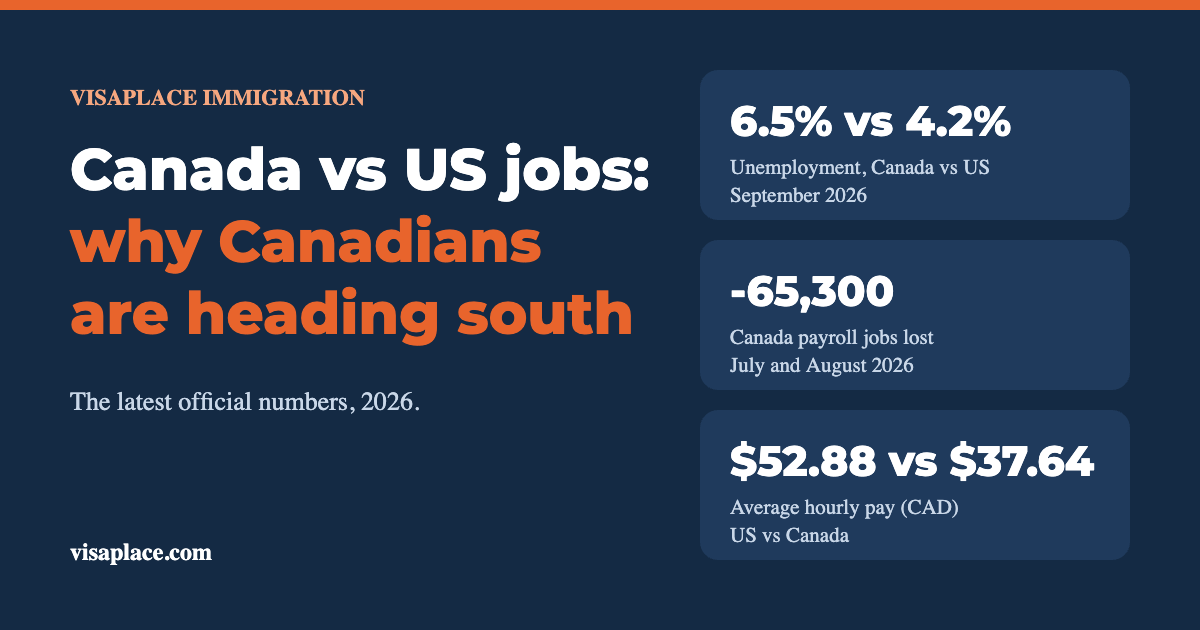
Canada’s job market has stalled in 2026, while the US keeps adding jobs and paying more. Here’s what the latest official numbers show, and what they mean if you’re thinking about working south of the border.
Does this sound like you?
- You’ve applied for jobs in Canada for months and heard nothing back.
- You’ve noticed the same job pays a lot more in the US, even after converting dollars.
- Your raise this year didn’t keep up with your rent or mortgage.
- Your kids are finishing school and you’re worried about where they’ll find work.
The short answer
- Higher unemployment in Canada: 6.5% versus 4.2% in the US in September 2026.
- Canada lost payroll jobs this summer, while US payrolls grew.
- US pay is higher: the average US hourly wage is about $52.88 in Canadian dollars, versus $37.64 in Canada.
- US pay is growing faster: 3.0% a year versus 2.3% in Canada.
- But US hiring has slowed too, so the right visa and a solid plan matter more than ever.
Unemployment: Canada is higher
Unemployment rate, September 2026
Youth unemployment in Canada (ages 15 to 24) in September 2026.
Share of unemployed Canadians who found a job the next month, down from 36.5% before the pandemic.
Jobs: Canada shrinking, the US growing
Change in payroll jobs, July and August 2026 combined
Statistics Canada’s Labour Force Survey shows the same trend: employment fell by 42,000 in August and by 68,000 in September.
Pay: higher in the US
Average hourly wage, in Canadian dollars
US wage growth over the past 12 months.
Canadian wage growth over the past 12 months.
The other side of the story
- US hiring has slowed too. The US added only 29,000 jobs in September. It’s still growing, but not booming.
- Pay isn’t everything. Taxes, health care and cost of living vary a lot by state and city.
- You need the right visa. Most Canadians can’t simply move and start working. A job offer, a business or family ties usually come first.
How Canadians are making the move
TN visa
For professionals with a US job offer, often approved at the border the same day.
E-2 visa
Buy or start a US business and move with your family. No job offer needed.
L-1 visa
Move to your company’s US office as a manager, executive or specialist.
Other routes
Family sponsorship, study and investment can also work.
Common questions
Is it easier to find a job in the US than in Canada?
Right now, the numbers point that way. In September 2026, unemployment was 6.5% in Canada and 4.2% in the US, and Canada lost payroll jobs over the summer while the US added them. But US hiring has also slowed, so it still takes the right job offer and visa.
Do jobs pay more in the US than in Canada?
On average, yes. The average US hourly wage was $37.81 USD in September 2026, about $52.88 in Canadian dollars, compared with $37.64 in Canada. Taxes, health care and cost of living vary, so compare the full picture for your situation.
Can a Canadian just move to the US and look for work?
You can visit to look for work and attend interviews, but you can't start working without a work visa. Many Canadian professionals use the TN visa once they have a job offer.
What US visa can Canadians get with a job offer?
The TN visa is the most common, for professionals in listed occupations. Others include the H-1B and, for company transfers, the L-1.
What if I don't have a US job offer?
You may still have options, such as the E-2 investor visa if you buy or start a business, family sponsorship or study.
See which US route fits you
Answer a few quick questions and see which US visas and green cards may fit you. Free, confidential, about 3 minutes.
Prefer to talk now? Call 866-934-7447
Sources: Statistics Canada, Labour Force Survey, September 2026 (released October 9, 2026). Statistics Canada, Payroll employment, earnings and hours, August 2026 (released October 29, 2026). US Bureau of Labor Statistics, The Employment Situation, September 2026 (released October 2, 2026). Bank of Canada daily exchange rate, October 29, 2026.
VisaPlace Immigration does not provide legal or financial advice. This page is for information purposes only. Figures are the latest available at the time of writing and may be revised. For legal advice, consult a licensed immigration lawyer.

President & CEO
Michael Niren
Mr. Niren is CEO of VisaPlace LLC and the President and Managing Partner of VisaPlace Legal Canada, an immigration law firm based in Toronto, and VisaPlace Legal US a law firm registered in The District of Columbia, USA. Mr. Niren is a graduate of Osgoode Hall Law School in Toronto, a member of the Law Society of Upper Canada, the Canadian Bar Association’s Citizenship and Immigration Section, American Lawyers Association, and an Associate Member of the American Bar Association.