By [Author Name] | Updated July 11, 2026 | 8 min read
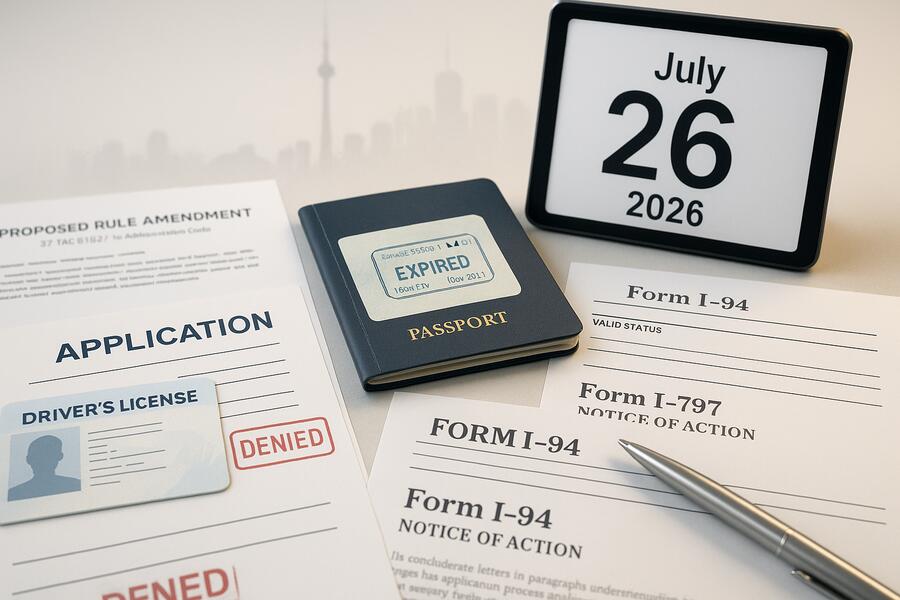
Quick summary: Immigration attorneys report that Texas DPS offices have denied driver’s license renewals to lawfully present H-1B, H-4, and F-1 visa holders over expired visa stamps, even though current Texas rule permits an expired visa when paired with a valid I-94. DPS has now proposed formally changing that rule, and the coverage has spread from immigration law firms to national outlets, including a widely shared Times of India report describing the situation as a “trap” for affected visa holders. Public comment on the proposed rule closes July 26, 2026.
If you hold an H-1B, H-4, F-1, or similar nonimmigrant visa and live in Texas, there’s a real, still-unfolding story you need to understand, not a rumor circulating on WhatsApp groups, but a documented regulatory dispute involving the Texas Department of Public Safety (DPS), immigration attorneys, and a formal rulemaking process with a closing deadline.
The short version: some DPS offices are rejecting driver’s license renewals from lawfully present visa holders because the visa stamp in their passport has expired, and DPS has proposed a rule change that would make that rejection standard practice statewide. This piece walks through exactly what’s confirmed, who is at risk, and what to do before the comment window closes, focusing on the implications of the Texas Driver’s License Visa Stamp Requirement.
The Story Has Gone National
What started as scattered complaints from individual workers has become a story picked up by mainstream and immigration-focused outlets alike. Immigration attorney Emily Neumann of Reddy Neumann Brown PC, one of the largest employment-based immigration firms in Texas, first documented the pattern publicly in late June. Since then, the situation has been covered by Newsweek, immigration law publications, and international outlets including a Times of India report in which an immigration attorney described the situation as a “trap” specifically affecting H-1B, H-4, and F-1 visa holders. That framing matters because it captures a detail easy to miss: this isn’t only an employee problem. H-4 dependents, the spouses and children of H-1B workers, face the identical documentary gap, often with even fewer backup options since many H-4 holders don’t have an Employment Authorization Document to fall back on.
What’s Actually Happening at DPS Offices
According to attorney accounts and reporting, the pattern looks like this: a lawfully present worker or dependent walks into a Texas DPS office to renew a standard driver’s license, presents a passport, a current Form I-94, and often an approved Form I-797, and is turned away because the visa stamp in their passport has expired.
Neumann has been direct about why she considers this a misapplication of Texas’s own rule. A visa stamp, she has explained, is a travel document used once to request admission at a port of entry. It is not a status document. After admission, it’s the Form I-94, not the visa page, that controls how long someone may lawfully remain in the country. DPS’s own guidance document (Form DL-17) lists a foreign passport containing a visa marked “valid or expired,” paired with a valid I-94, as an acceptable identity document. When someone meeting that exact description is denied anyway, attorneys argue the office is departing from the regulation rather than following it.
One widely referenced case involved a worker who had changed from F-1 STEM OPT status to an approved H-1B without yet obtaining a new visa stamp abroad. DPS’s system still displayed the applicant’s old F-1 status. The officer initiated a SAVE (Systematic Alien Verification for Entitlements) check with the Department of Homeland Security, which took two to three weeks to return, before the renewal was finally approved.
Other attorneys who spoke to reporters have suggested a less charitable possibility: that some denials may not be simple training errors. Frontline DPS staff are effectively being asked to interpret nuanced federal immigration law in real time, at a counter, without legal training, which naturally produces inconsistent outcomes even when the underlying rule is written clearly.
Why DPS Wants to Change the Rule Anyway
Here’s where this stops being just an enforcement inconsistency and becomes a genuine policy shift. DPS has formally proposed amending 37 Texas Administrative Code section 15.24 to delete the words “or expired” from its identity-document rule. If adopted, a foreign passport would only qualify as a primary identity document for REAL ID purposes when the visa stamp inside it is still valid.
DPS says the change is needed to align with the federal REAL ID regulation at 6 C.F.R. section 37.11. Immigration attorneys counter that the underlying federal statute is actually broader than DPS’s proposed interpretation, since Congress used the word “or” when describing a person who holds a valid visa or valid nonimmigrant status, not “and.” That distinction is the entire dispute in miniature: should current, verifiable status be enough, or must the visa stamp itself still be unexpired?
Why This Creates a Documentary Dead End
Texas generally lets applicants prove identity through one of three routes: one primary document, two secondary documents, or one secondary document plus two supporting documents. For most foreign-born visa holders, the secondary-document list, mostly U.S. or Canadian birth certificates and certain court orders, simply doesn’t apply, which leaves only the primary-document path.
For a nonimmigrant without an Employment Authorization Document, that narrows to two realistic options: a foreign passport with an unexpired visa plus a valid I-94, or an existing Texas driver’s license or ID that hasn’t expired more than two years. Under the proposed rule, the first option vanishes the moment the visa stamp expires. A passport alone becomes only a supporting document. An out-of-state license is also only a supporting document in Texas. Neither can carry an application on its own, which means someone with a valid passport, current I-94, approved I-797, valid Social Security card, and verifiable status through SAVE could still fail Texas’s identity test on a technicality that has nothing to do with who they are.
Who’s Most Exposed
- H-1B workers who changed employers, extended status, or transferred without getting a new visa stamp abroad
- H-4 dependents of H-1B workers, who often carry the same expired-stamp risk with fewer backup documents
- F-1 students who moved to STEM OPT or H-1B status without a matching new visa stamp
- TN and E-2 professionals, whose visa stamps tend to be shorter-duration relative to their authorized stay
- Anyone relocating to Texas from another state after their visa stamp already expired, since an out-of-state license won’t rescue the application under the proposed rule
Largely unaffected: U.S. citizens, permanent residents (who use Form I-551, not a visa stamp), refugees and asylees (who rely on I-94 endorsements), and most Employment Authorization Document holders, since an EAD independently satisfies the identity requirement.
What To Do Before July 26, 2026
If your visa stamp is still valid, apply for or renew your Texas driver’s license now, while the passport-plus-visa combination still qualifies. A current Texas credential becomes a primary document in its own right afterward, creating a bridge through future renewals, provided you never let it lapse more than two years.
If your visa stamp has already expired, bring every current status document you have (I-94, I-797, employer letters) and be prepared for the office to initiate a SAVE verification, which can take two to three weeks. Ask directly whether the office is applying Section 15.24 as currently written, since the “or expired” language technically still stands until the amendment is adopted.
If you’re relocating to Texas, try to complete your Texas licensing process before your visa stamp lapses and before the move, if your timeline allows it.
Submit a public comment. DPS is accepting comments on the proposed amendment to 37 TAC §15.24 through July 26, 2026, by email to DLDrulecomments@dps.texas.gov. Comments from affected individuals, employers, and universities are part of the public record DPS must consider before finalizing the rule.
Have questions about the Texas Driver’s License Visa Stamp Requirement? Reach out to our team today.
Frequently Asked Questions
Does Texas currently require a valid visa stamp for a driver’s license?
Not under the rule as written today. Current Texas regulation accepts a foreign passport with a visa marked “valid or expired,” paired with a valid I-94. Enforcement in practice has been inconsistent, and a proposed amendment would remove the “or expired” language entirely.
Are H-4 visa holders affected by this issue?
Yes. H-4 dependents face the same documentary gap as H-1B workers, and coverage of this story, including reporting picked up by Times of India, has specifically named H-4 holders alongside H-1B and F-1 as at-risk groups.
Does an I-797 approval notice replace a visa stamp?
For lawful-presence purposes, yes, combined with a current I-94 it demonstrates valid status. For Texas’s separate identity-document requirement, it does not currently substitute for an unexpired visa stamp under the proposed rule.
What happens if my renewal is denied?
You may be asked to undergo additional SAVE verification, which has taken two to three weeks in reported cases, during which you may be without a valid license for driving, work commutes, or identity verification.
When does the public comment period close?
July 26, 2026. Comments go to DLDrulecomments@dps.texas.gov.
The Bottom Line
This remains an active, unresolved regulatory fight, not settled law. Texas’s official rule today still permits an expired visa stamp when paired with a valid I-94, which is why attorneys argue current denials are inconsistent with the state’s own regulation. But DPS has clearly signaled its intended direction, and the proposed amendment to 37 TAC section 15.24 would convert today’s inconsistent enforcement into tomorrow’s firm rule.
If you hold a nonimmigrant visa, especially H-1B, H-4, or F-1, and live in or are moving to Texas, treat your current visa stamp’s validity as a closing window, not a formality. Lock in your Texas credential now if you can, document everything if you can’t, and if this issue affects you, put it on the record before July 26, 2026.
Book your consultation https://www.visaplace.com/bookonline/ We’ll review your situation, explain your options, and help you navigate the latest immigration developments with confidence.
This article is based on public reporting from Newsweek, Reddy Neumann Brown PC, Great Andhra, and coverage referenced by Times of India, along with the publicly posted text of the proposed rule as of July 2026. It is for general informational purposes only and is not legal advice. Confirm your specific situation with DPS directly or a licensed immigration attorney.